Review: “Her Naked Skin” by Rebecca Lenkiewicz, produced by Shattered Globe Theatre at Stage 773 through June 3. ****
By Lawrence B. Johnson
To list the intriguing features of Rebecca
Lenkiewicz’s play “Her Naked Skin,” you could start with its title, then note that the story appears to be – but isn’t exactly — about the women’s suffrage movement in England circa 1913. Nor is it
strictly a love story, though that forms (in more than one sense) its heart.
What “Her Naked Skin” ultimately proves to be, and what makes Shattered Globe Theatre’s production a sleeper gem of the season, is the journey of one woman from the shadows and constraints of her conventional, secure world into the
bright, life-altering light of self-awareness and self-realization.
That migration fills the stage and commands our
sympathies as the aristocratic Lady Celia Cain follows impulse as much as conviction down a path to she knows not where. She is indeed surprised at the challenging place where her fortunes land her,
and so are we; and that’s the beauty of Lenkiewicz’s wise play as well as the appeal of this account directed with raw energy and edge by Roger Smart.
The 44-year-old British playwright, winner of several national awards for her work, became the first living female to have a play
mounted on the Olivier Stage at London’s National Theatre when “Her Naked Skin” was produced there in 2008. Lenkiewicz has said she was
inspired to write the play after reading Midge Mackenzie’s book “Shoulder to Shoulder,” about the British suffragettes, whose campaign for the vote lasted
for generations, escalated into violence and saw activists jailed and severely abused before universal suffrage finally won out in 1928.
“Her Naked Skin” is very much a war story. In the
midst of the suffragettes’ increasingly militant campaign – advocates have begun smashing windows and setting fires to press their cause – the activist Lady Celia Cain (the genuinely
patrician Linda Reiter) draws yet another sentence in a series of prison terms, typically four to
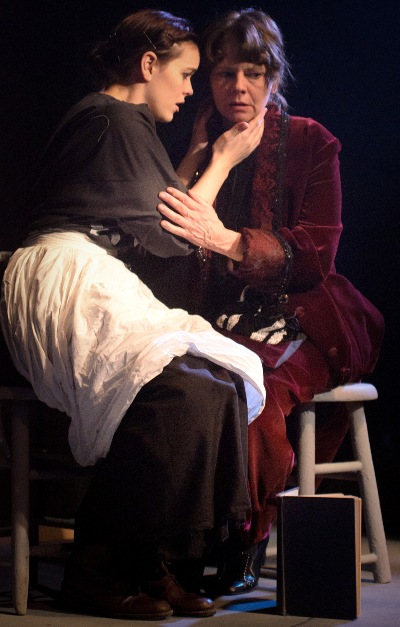
eight months. But this time Celia, the mother of seven children whose marriage is severely strained by her advocacy, is incarcerated with a young seamstress called Eve (Sheila O’Connor) and swiftly succumbs to the girl’s fresh beauty. Thus begins a torrid lesbian affair that continues after
both women are released from prison.
Reiter’s worldly aristocrat, as emotionally vulnerable as she is intellectually imposing, and O’Connor’s lovely, earnest Eve make convincing lovers. And director Smart draws us
into their intimacy by showing Celia to be absolutely smitten. That is critical to all the difficult events that follow.
Their passion is cast against the warlike campaign for
women’s right to vote and the violent reprisals on women who have been sent to prison. A historical tactic of the imprisoned suffragettes was to go on hunger strikes, which were met with brutal
forced feedings depicted here with shuddering realism. The play also shows us Parliament, where contemptuous men opposed to the women’s vote not only endorse the brutality but also insist that the
suffragettes’ irrational behavior only illustrates the incompetence of women to play any role in governance.
(To witness Shattered Globe’s staging of these
derisive rants is to marvel that universal suffrage ever prevailed. In fact, the first law to be passed, in 1918, limited the women’s vote to those at least 30 years old who held certain property;
the final version, ten years later, gave the vote to all British citizens at age 21. Universal suffrage in the U.S., also hard won through dogged campaigns dating back to the early 1800s, became law
with the 19th amendment to the
Constitution in 1920.)
While she’s caught up in this heady whirl of
revolution and romance, Celia is also struggling with a marriage on the rocks. She’s completely dependent on her rich but alcoholic husband William, brought to a fine pitch of noble torment
in Tim Newell’s splendid performance. Celia has no evident way out, and though her husband
defends her honor, he’s had quite enough of her revolutionary embarrassment.
Eventually comes that day of cold light when Celia
must assess her life – the suffrage movement, her affair, her marriage – and put it all in order. And when this intelligent and aspiring and caring woman Linda Reiter has formed before our eyes makes
her hard choices, we believe them. We have not come to a happy-ever-after, but a turning point: Celia has many a challenging mile to go.
“Her Naked Skin” presses a large cast of characters –
jailers, doctors, MPs, demonstrators – into the small performing space at Stage 773. That compression intensifies the hurly-burly in the
streets and brings us heart to heart with intimacy. Andrew Hildner’s multilevel set well serves both extremes, and Lindsay Schmeling’s period costumes — blooming undergarments everywhere — put a
flavorful stamp on the scene. Not least, to each soul in this cross-section of life in time of foment, Shattered Globe’s company gives a distinctive face and bearing.
Her
Naked Skin THEATER REVIEW by Jonathan Abarbanel, Windy City
Times
FYI: British women
gained the vote in 1918, two years ahead of U.S. women.
Playwright: Rebecca Lenkiewicz. At: Shattered Globe
Theatre at Stage 773, 1225 W. Belmont Ave. Tickets: 773-327-5252; www.shatteredglobe.org; $18-$34. Runs through June 3
The BBC's marvelous 1974 dramatic
series, Shoulder to Shoulder, related the history of the women's suffrage movement in Great Britain, the title coming from the marching anthem of the suffragettes. The series later was big hit on
PBS. Her Naked Skin acknowledges Shoulder to Shoulder as its inspiration and source, which makes me wonder why it was written. Despite a strong production by Shattered Globe, Her Naked Skin doesn't
satisfy as history or as a play about women.
Part of the reason why is that it
can't decide what it wants to be. Set in 1913, it begins as a history play about the suffragettes and the repressive reactions of the male-dominated political establishment, all material that the
earlier TV series (and book) covered in far more devastating detail and depth. However, the politics quickly disappear as prominent historical figures such as Prime Minister Herbert Asquith and Lord
Curzon vanish after two or three scenes.
That leaves Her Naked Skin as a
play about women discovering and empowering themselves, and confronting social norms including sexual and sensory experiences. The play's fictional story explores these aspects, set within the
history of suffragism.
The central tale tells of
fictional suffrage leader Lady Celia Cain and the working-class follower, Eve Douglas, she meets during one of the many brutal imprisonments suffragettes endured (forced feeding, rape, denial of due
process). They have a compelling affair but ultimately Lady Celia breaks it off, unable to overcome the ultimate English taboo of choosing a partner beneath one's socioeconomic class. Indeed, both
Celia and Eve are victims of their own conventionality, although the play barely touches this aspect. Audiences in the UK (where this play began) would understand this instinctively, but U.S.
audiences do not. What makes the play more bittersweet is that Cain also leaves her liberal and supportive husband apparently because he cannot fulfill her physically (after years of marriage and a
number of children), something which he ruefully comes to understand.
Shattered Globe has created a
powerful physical production with the help of Andrew Hildner's dominating two-story prison set (with nifty hints of lacy Victorian ironwork) and Lindsay Schmeling's good period costumes. The huge
cast of 18 is mixed in quality, but the lead performances by Shattered Globe stalwart Linda Reiter (Lady Celia) and Sheila O'Connor (Eve) are quite wonderful (and they both are lovely women, if I may
be forgiven a sexist opinion). Tim Newell is persuasive as the unhappy Sir William Cain, who risks his career to defend his wife's name. Under astute director Roger Smart they engage our sympathies,
but they cannot knit together the play's various loose ends and subjects.
Rebecca Lenkiewicz’
play, Her Naked Skin, premiered in 2008 at the National Theatre in London, and is notable as the first play performed on the
Olivier stage by a living female playwright. Based on the book “Shoulder to Shoulder” by Midge Mackenzie, the piece explores the lives and works of leading British suffragettes
through fictional characters.
Before the play begins, one noticesAndrew Hildner’s stark,
grey stage evoking a women’s prison, with staircases that lead to sliding doors representing holding cells. The doors slide open to reveal moments of despair, lust, and brutality, like some kind of
advent calendar of human emotion. Smoky air fills the set, adding a downtrodden, workaday quality to the atmosphere. Add to thisCharlie Jolls’ lighting design and Christopher Kriz ’ sound design of ambient prison sounds, and an
experience is created that pulls the audience into the action in a sensory-heavy environment.
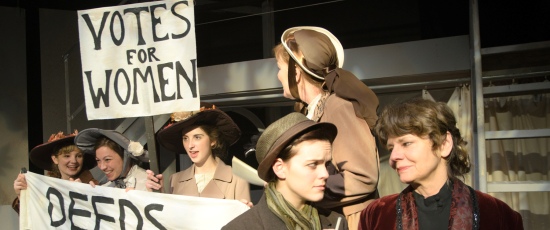
The action begins with a demonstration for
women’s suffrage where the principal characters meet: Celia Cane (Linda Reiter) an ageing matron, and Eve Douglas (Sheila O’Connor ), a
young factory worker. The group breaks windows as a demonstration, and is summarily arrested and taken to prison, where they face sentences several months long. Celia and Eve are assigned as
cellmates, and being the elder of the two, Celia imparts wisdom to her young cohort.
Celia’s husband, William Cain (Tim
Newell) arrives at the prison unannounced, surprising the audience as much as Celia herself – just moments earlier she’d told Eve that she had never married, and was a virgin, when in fact
she is the mother of 7 and wife of an MP! The relationship between Celia and William is tense, but not without moments of tenderness, and completely believable. Their arguments are terse and snippy,
with dialogue like: “I have a brilliant sense of humor, it simply eludes you.” The language throughout the piece is dry and witty, and a delight to the ear. At one point Celia remarks: “Adam and Eve
would have smashed each other’s skulls with spades.”
One of the few tools available to the British
suffragette movement is hunger strikes by prisoners, which are responded to by force-feeding at the hands of prison guards and doctors, a procedure enacted onstage in what is the most compelling
scene in the play.
There is a boy’s club feel to the PM sessions
that feel genuine and hearty; British Parliamentary procedure has always seemed like a spectacle, with the heckling, the one-upping, and the ribbing. On the floor of the Parliament is the issue of
women’s suffrage, and the cast does a tremendous job of bringing these scenes to life.
The relationship between Celia and Eve is
surprising and subversive in the context of the time, and of the characters’ respective situations. There is lustiness between Celia and Eve that is sustained, and one becomes sympathetic to their
impossible situation.
Her Naked
Skin is as much an exploration of relationships as it is of the women’s suffrage movement in England, with Celia and Eve’s connection, and Celia and William’s connection at the
forefront of this exploration. Supporting the principals are a capable cast which includes Maya Friedler as Mrs. Shliefke, the elder suffragette in the
group, Jesse Thurstonas Guard/MP,
and Drew Schadas Edward Grey/Dr. Vale.
Lindsay Schmeling ’s costume design and Kathy Logelin’s work as Dialect Coach add authenticity to the production,
and allow the audience to experience the story seamlessly. Shattered Globe has created a heartfelt, informative story through this complex production; one that will leave you wondering about women’s
roles in society, past and present.
Overlapping story lines about the Suffragette Movement and a lesbian
love affair fizzles
The potential of Her Naked Skin to be a powerful
theatrical event get mired into a lesbian love affair story after an encouraging start. We meet a mixed class of British women in 1913 who are militant in their determination to win the vote and
equal rights in Edwardian England. They march, protest and create social havoc designed to get their political agenda in the news to influence the British Parliament to give women the right to
vote. The focus of the early storyline is on Lady Celia Cain (Linda Reiter) and her group led by Florence Boorman (Melissa Riemer). They brake windows in order to get arrested and sent to Holloway
Prison. There they go on hunger strikes to highlight their cause. We see how the British government force feeds food into their bodies to prevent any deaths.
While these events were dramatized, the suffragette story becomes a lesbian love affair as Lady Celia Cain, a
middle aged wife and mother of five falls in love with a young seamstress, Eve Douglas (Shelia O’ Connor). Lady Cain’s powerful lawyer husband, William (Tim Newell) revert to drink as her becomes
more and more alienated from his wife of many years.
After a promising start, Her Naked Skin becomes a slowly
paced personal story revolving around Douglas and Cain. We don’t see enough of what happens to the Suffragette Movement as England gets into the Great War. We see that eventually Eve and Celia
separate, that Celia never resolves her marriage problems, but we never know what happens to the women’s Movement? We are never told that the Suffragettes did actually stop their actions to be
patriotic Brits during the war and that the women won their rights in 1918.
I found Her Naked Skin to be 2o minutes too long and the blend of the two stories
short-changed the suffragette’s story. Linda Reiter and Shelia O’ Connor gave excellent performances. The ensemble work by the large cast was fine. Tim Newell had many terrific
moments as the troubled husband. The production values, set design by Andrew Hildner with period perfect costumes by Lindsay Schmeling, served the production well.
★★★★★Shattered Globe Theatre, now celebrating 20 seasons of theater in Chicago, since its inception, has always tried to bring works to its
stage that are a little bit different from other companies; intimate character driven stories that speak to the universal aspect of what it means to be a part of the “Human Experience”. Their current
production, under the direction of Roger Smart ( one of the original members of this company) is one that does just that. “Her Naked Skin” written by Rebecca Lenkiewicz, who was inspired by the novel
“Shoulder to Shoulder” by Midge Mackenzie in documenting the lives and work of Britian’s leading suffragettes during the early 1900′s in England.
While much of this story is based on some actual history, letters, articles, speeches and memoirs of the women involved, as always, writers add their
own touches and personal experiences that may be related, in fact, or hearsay to the actual events, which in many cases are more stimulating than the actual stories. This is a story about the problem
of equal rights for women, one that has existed for eons and while things are far better in modern times, we still hear of the “equal job-equal pay” strikes and picketing today!. I must tell you that
I was impressed by the set designed by Andrew Hildner to make the best use of the “THE BOX” theater at Stage 773. The majority of the set is the prison where the women were placed and abused when
they demonstrated. The levels and doors and even the stairways made for a very realistic prison. Yet, with a curtain and a few pieces of furniture, voila, we are a gentlemen’s club, or a senate
hearing room, with the action outweighing the set at all times. Hats off to Vivian Knouse for assembling a lot of props that were the icing on the cake for bringing reality to the stage. The music
before the play and during several scene changes adds to the mystery of where the story is headed and with no program note, I will have to give credit to the sound man Christopher Kriz.
Charles Jolls lighting worked to perfection and Lindsay Schmelling’s costumes were of great and fitting design, but limited in numbers ( it seems
that even the women of prosperity had only one outfit that was worn every day for weeks and weeks. I guess I should be less picky, but it was very noticeable with our principle , Celia Cane ( deftly
handled by the strong Linda Reiter). Her husband, William, who has turned to drink to offset his missing wife is played to perfection by Tim Newell and Celia’s love interest, Eve is handled by the
lovely Sheila O’Connor.
The ensemble works hard to make this play really work and while there are many fine moments, I for one found that two and a half hours was far to
long to tell this lovely little love story. This is a small theater and so, noticing several “sleepers” or dozers causes others to lose concentration and focus on a historical story about “freedom”.
Not just the freedom to vote or the freedom to work, but the freedom to make choices- choices of your won. Freedom to have a love interest that is not what society wants or expects you to have, so
while I liked the concept, I would have found it a bit more intriguing to get to the heart of the matter and to bring these characters lives to completeness in the end. This is a story that offers
history and some intrigue about the people of the time- those shackled by their lives, both on the inside and outside.
“Her Naked Skin” will continue at Stage 773 ( formerly The Theatre Building)located at 1225 West Belmont, through June 3rd, with performances as
follows:
Thursdays and Fridays at 8 p.m. ,Saturdays at 3 and 8 p.m. and Sundays at 3 p.m.
In Shattered Globe Theatre's Her Naked Skin , the year 1913
finds Great Britain's suffragette movement in full force, as women in every class distinction take to the streets, and eventually to its "ladies'" prisons, in protest to demand the right to vote, to
serve politically, to make their own life choices, to stand toe-to-toe with the male populace.
The suffragette's fight is far from dainty, as Britannia's iron
jawed angels are met with crushing blows from the resistance of Parliament, the fists of intolerance at rallies, the frequent arrests and finally revolving door imprisonment at Holloway, where
inmates are met with equal treatment at the hands of hostile matrons, sexually abusive guards, and a physician who smashes through their teeth and lungs to force feed hunger strikers — for
humanitarian reasons, of course.
Photo by Kevin Viol
The war cry of the women's' movement attracts a diversity of
soldiers, including Lady Celia Cain (Linda Reiter), well-bred and upper classed, but slowly smothering in her marriage to William (Tim Newell), a man who summons all he can emotionally muster to
stand by his wife in her open declaration of war in the fight for women's rights, yet grows more tired and drunker from the humiliations and questioning of his manhood from the boys at the club and
office. Lady Celia is grateful for her husband's wan support — which wanes as her civil and matrimonial disobedience and Holloway visits become more frequent. As William sinks further into drink and
anger, Lady Celia uses her time at Holloway nursing the movement's militancy and becomes closer to the seamstress Eve Douglas (Sheila O'Connor), a young working class woman equally committed to the
suffragette movement.
The other suffragettes readily accept the romance of Eve and Lady
Celia; prison personnel look away, the women's secret kept safe. Despite the brutal reality of their imprisonment, both blossom individually and in political and romantic partnership. But it's still
1913, and the choices for a woman to live her life as she wants are far more oppressive outside the Holloway walls, as Lady Celia must face upon release.
The women continue their romance, which in freedom's light becomes
more subdued, closeted, cloistered. Eventually Lady Celia must face the reality that "equality" requires means and finance, while Eve comes to realize that the gender caste system intertwines with an
impenetrable class system and those who scream the loudest for the change of the former are unwilling to sacrifice any part of the latter. Her Naked Skin can be suffocating and disturbing to view, if only because the more things change, the more things stay the same, or are destined to
worsen. We face daily headlines about the new "War on Women," yet I'm not so sure this "war" is so much new as a continuation of what those suffragettes of 1913 faced. Future suffragettes rested upon
their singed laurels, calling for cease fire far too early in the battle.
It's hard to view the horror of history and say I
enjoyed Her Naked Skin, but I'm certainly glad I saw it, and I highly recommend to anyone who wonders where Rush Limbaugh gets off publicly calling a
woman "slut" for advocating birth control choice in 2012 (or anyone who's sitting on pins and needles awaiting the third season of "Downton Abbey"). Shattered Globe's ensemble cast performs
seamlessly, gifting us a reenactment of a far away time that's not so far away, and may be a look into our future, but only if there are women willing to spend time away from material comforts and
societal status to fight the good fight thru the end.
Special kudos go to the technical team, including scenic designer
Andrew Hildner, and lighting designer Charles Jolls, for creating a set where the women's Holloway imprisonment felt like victory and liberation, and life outside prison walls felt stifling,
repressive, and without compromise.




 Shattered Globe Theatre, now celebrating 20 seasons of theater in Chicago, since its inception, has always tried to bring works to its
stage that are a little bit different from other companies; intimate character driven stories that speak to the universal aspect of what it means to be a part of the “Human Experience”. Their current
production, under the direction of Roger Smart ( one of the original members of this company) is one that does just that. “Her Naked Skin” written by Rebecca Lenkiewicz, who was inspired by the novel
“Shoulder to Shoulder” by Midge Mackenzie in documenting the lives and work of Britian’s leading suffragettes during the early 1900′s in England.
Shattered Globe Theatre, now celebrating 20 seasons of theater in Chicago, since its inception, has always tried to bring works to its
stage that are a little bit different from other companies; intimate character driven stories that speak to the universal aspect of what it means to be a part of the “Human Experience”. Their current
production, under the direction of Roger Smart ( one of the original members of this company) is one that does just that. “Her Naked Skin” written by Rebecca Lenkiewicz, who was inspired by the novel
“Shoulder to Shoulder” by Midge Mackenzie in documenting the lives and work of Britian’s leading suffragettes during the early 1900′s in England.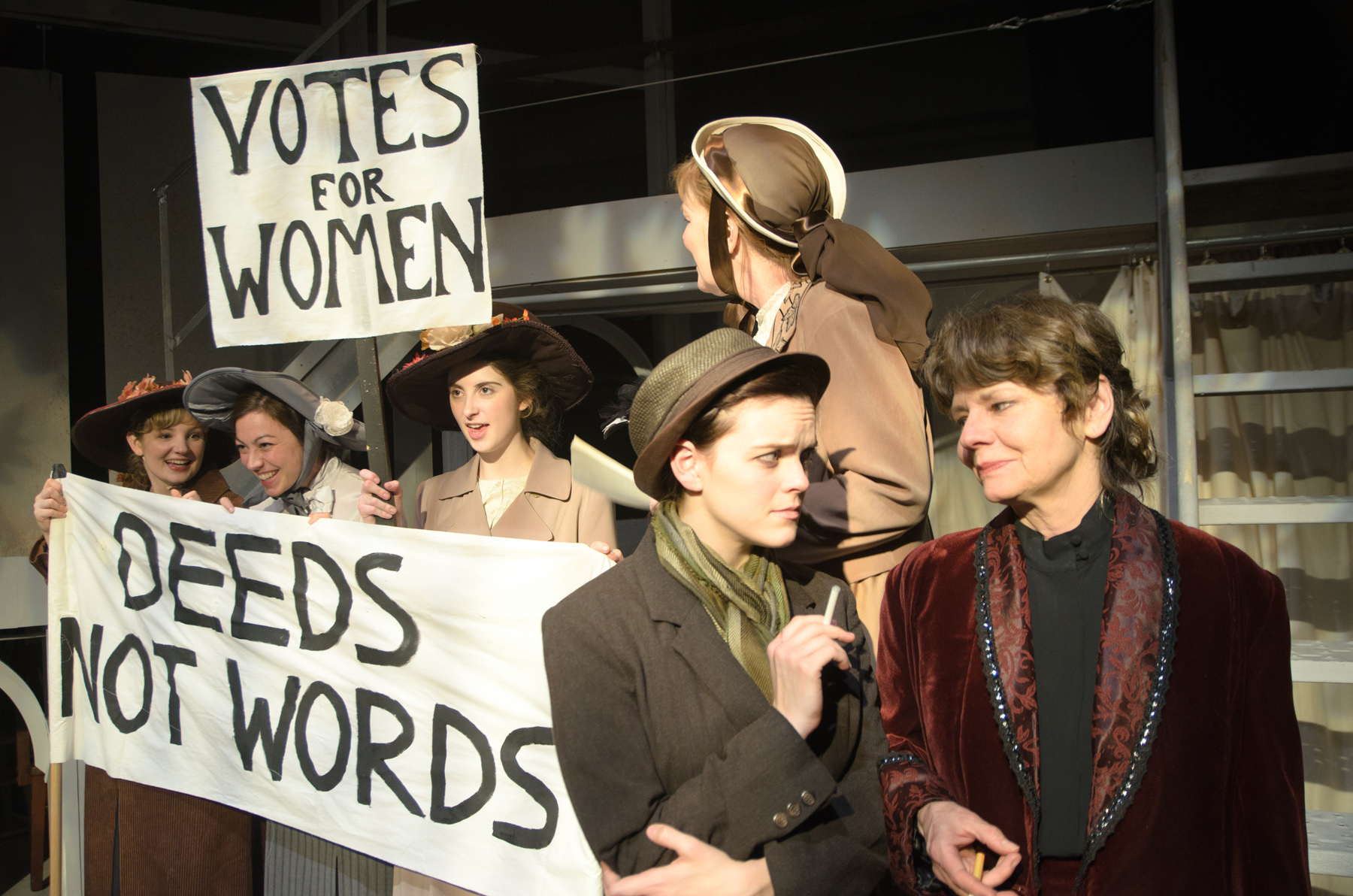

 Print
Print